TF-nucleosome Interaction Help Documentation
Comprehensive Guide: How to Use Our Prediction Tool
1. Homepage Interface
1.1 Navigation Bar
- Home: Return to main website
- Data Query: Access cross-species prediction database
- Prediction: Navigate to TF-nucleosome prediction tool
- Help: View documentation
1.2 Main Modules
- Cross-species prediction results: Click "Start Exploring" to query database
- Online Prediction: Click "Start Prediction" to access prediction tool
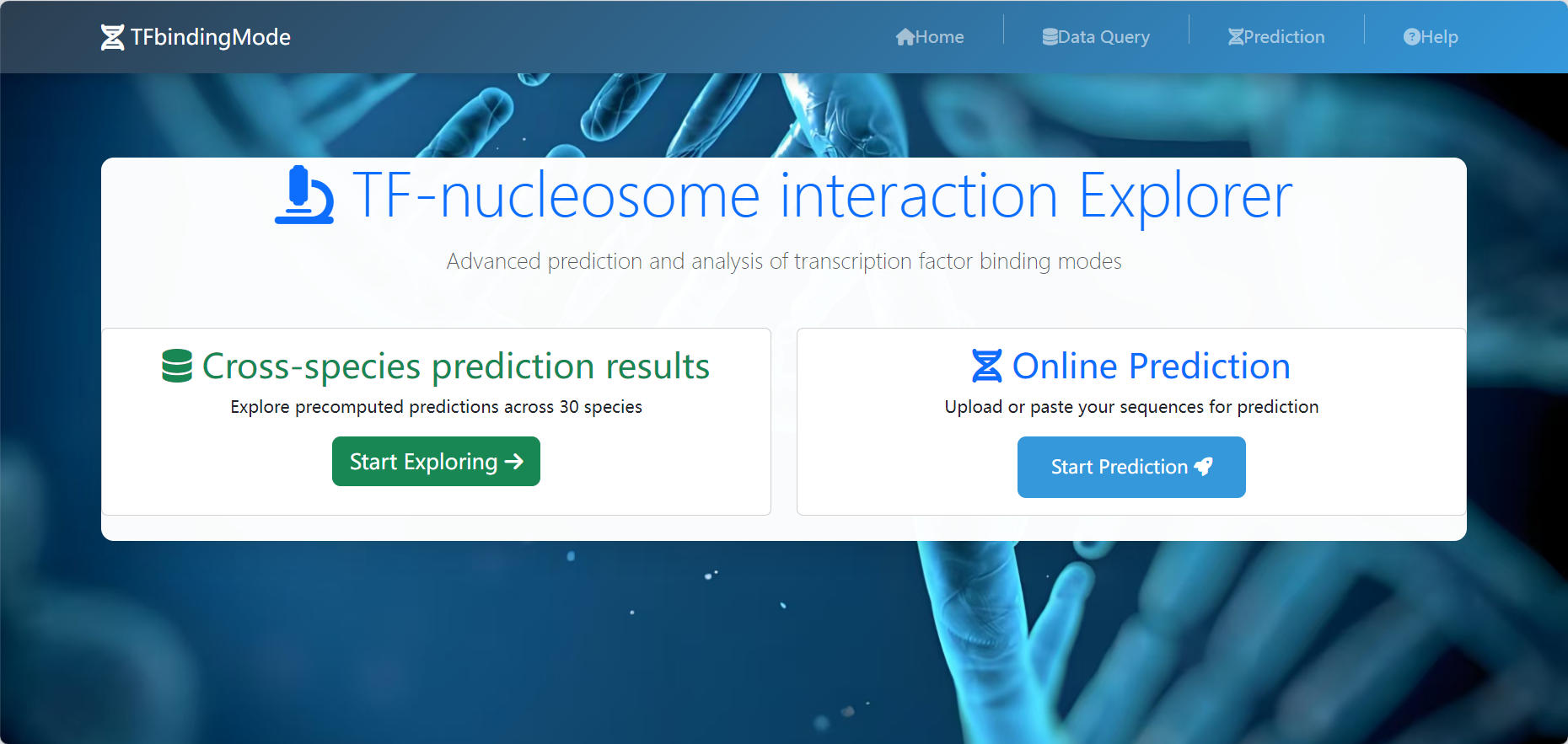
Figure 1: Website homepage interface
2. TF-nucleosome Browser
Click search box or dropdown to display 30 species. Select target species and click Query to view predictions.
- Select All: Check all predictions for selected species
- Export: Download results locally (Filename format: result_species_timestamp)
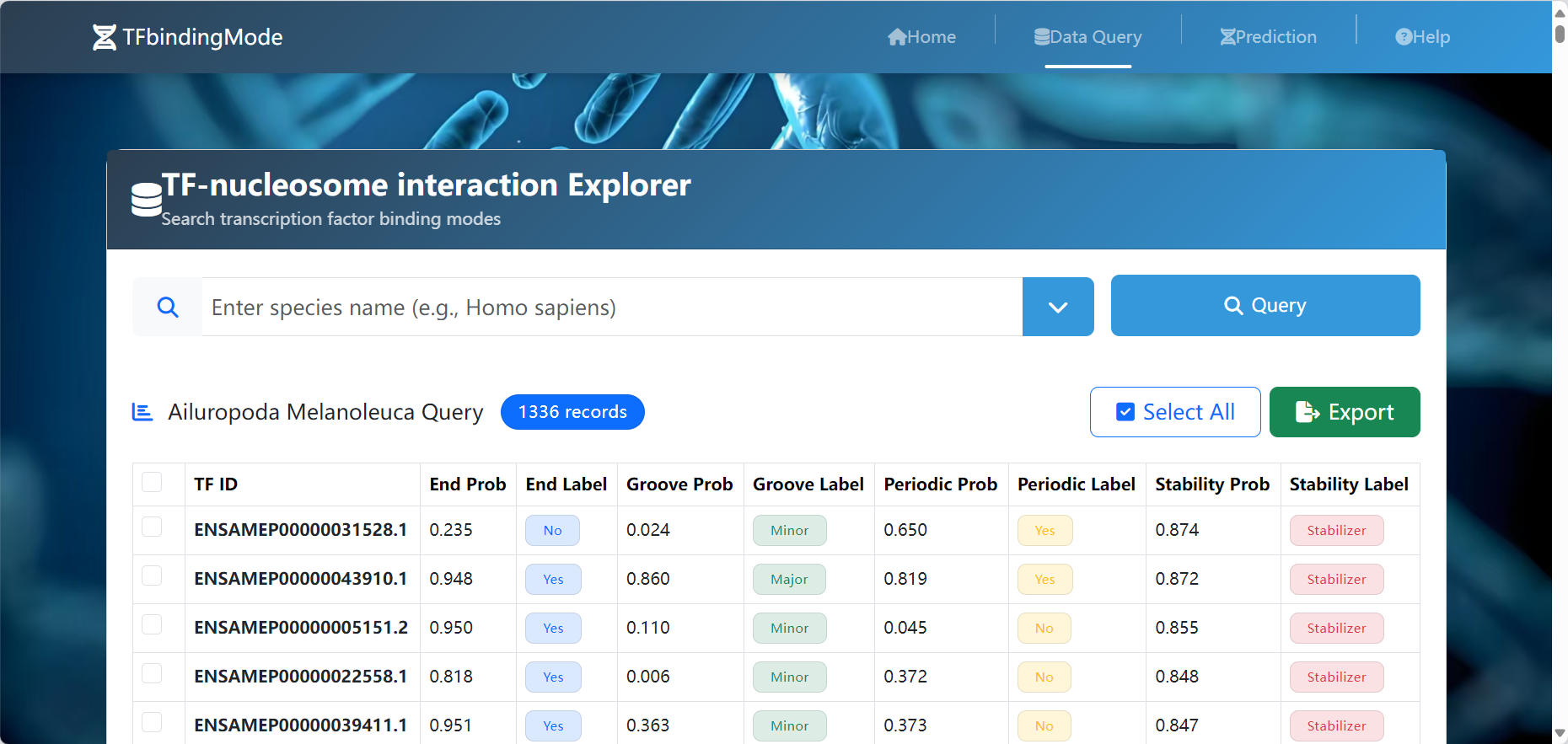
Figure 2: TF-nucleosome browser interface
3. TF-nucleosome Interaction Prediction
Two prediction methods available:
Text input: Directly enter protein sequences in text box
File upload: Upload FASTA format sequence files
3.1 Sequence Input
- Input format: Protein sequences (Multiple sequences supported, see example)
- Clear Input: Reset all input content
- Run Prediction: Execute prediction on input sequences
- Example sequences used if input is empty
- Select All: Check all prediction results
- Download: Export results locally (Filename format: Prediction_input-fast_timestamp)
Example Format
>Protein_001
MAHVSSETQDVSPKDEL...
>Protein_002
MDEDEFELQPQEPNSFF...
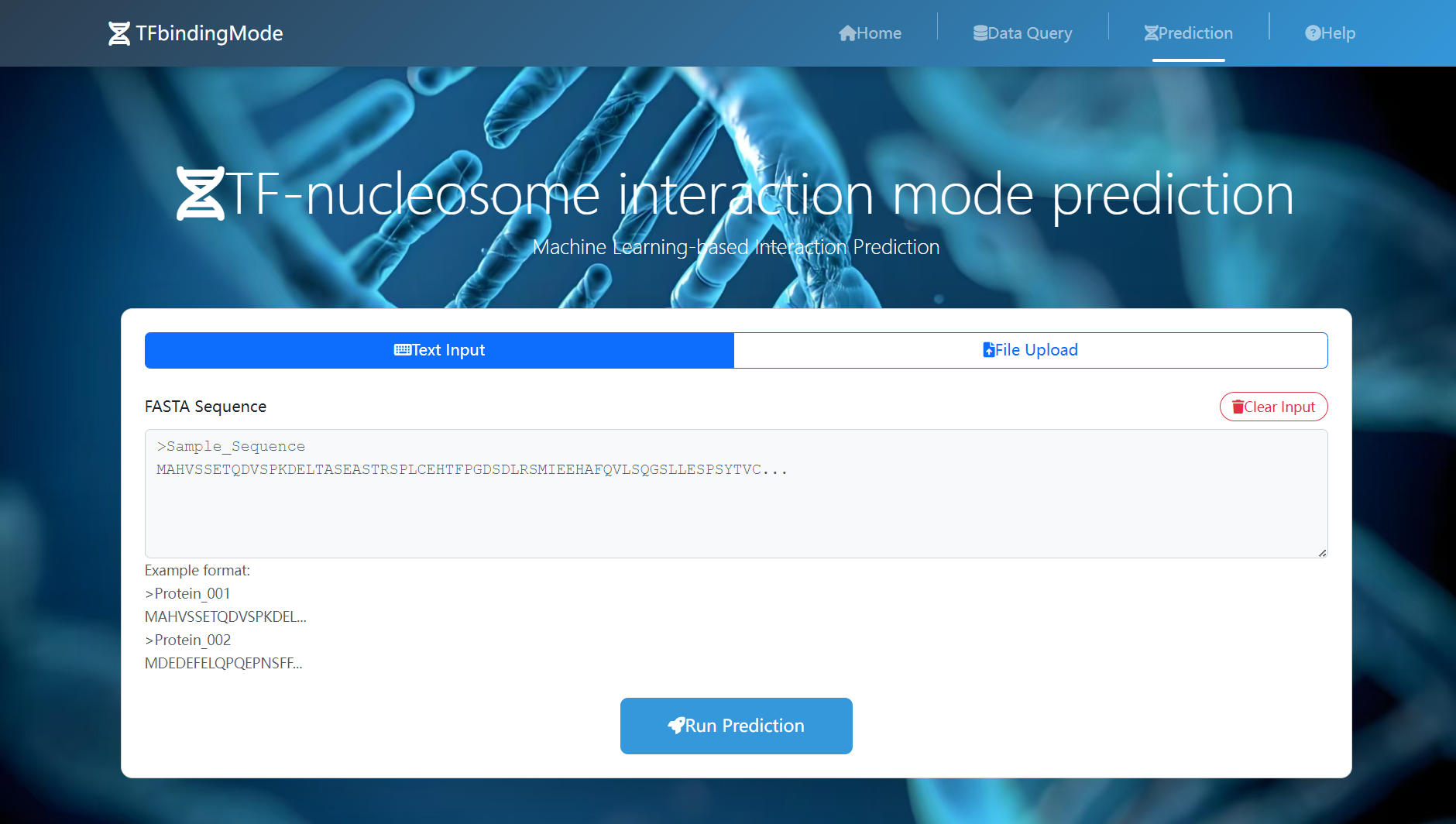
Figure 3: Sequence input interface
3.2 File Upload
- Format requirements: FASTA formatted protein sequence file
- File size: Maximum 10MB
- Run Prediction: Execute prediction on uploaded sequences
- Select All: Check all prediction results
- Download: Export results locally (Filename format: Prediction_filename_timestamp)
- Download example file for format reference
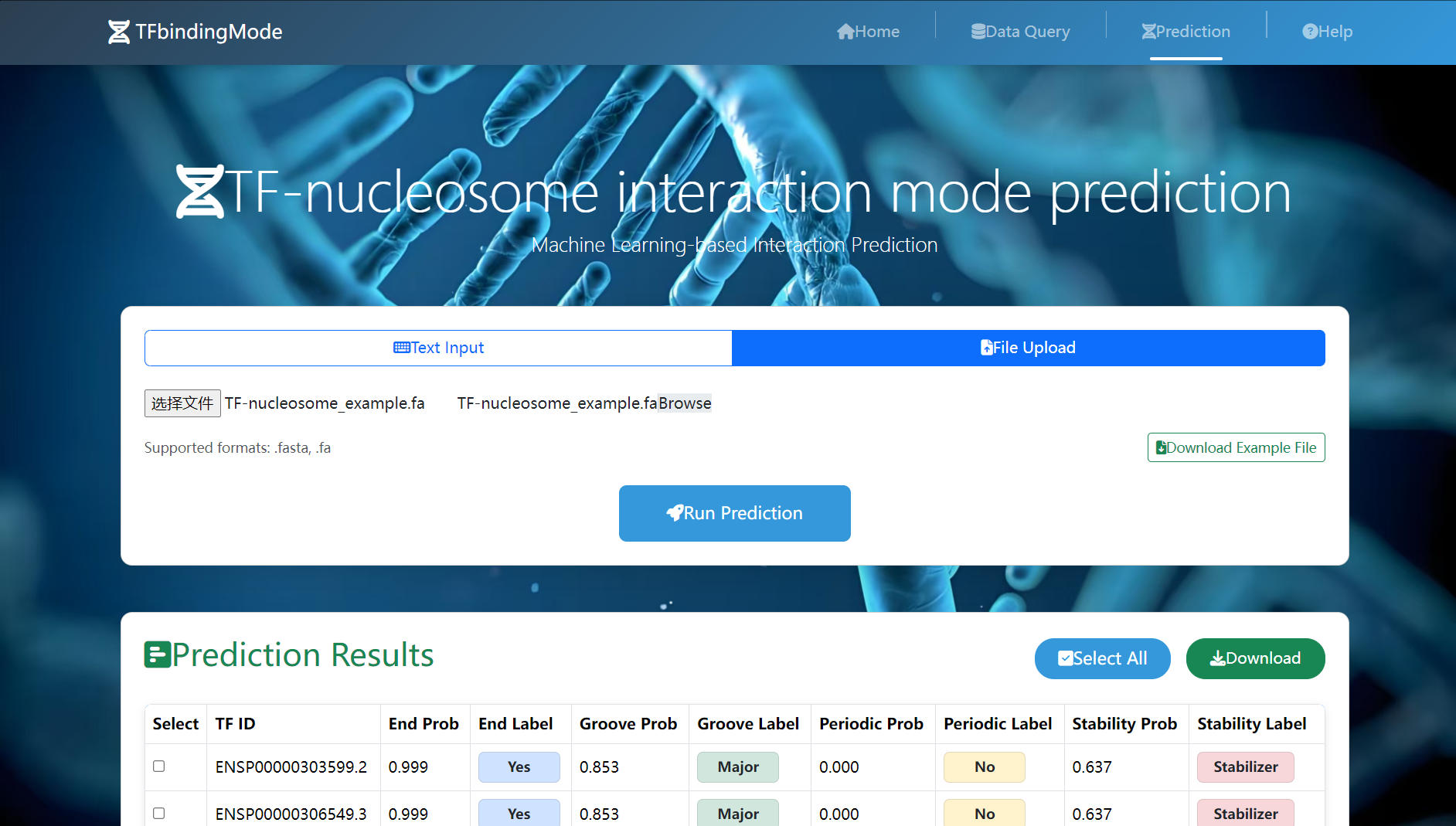
Figure 4: File upload interface
Result Interpretation Guide

Figure 5: Prediction results interface
Prediction Metrics Explained
| Metric | Interpretation |
|---|---|
| TF ID (Transcription Factor Identifier) |
Unique identifier of a transcription factor (e.g. ENSAMEP00000031528.1) |
| End Prob (End-binding Probability) |
Probability of the TF binding to nucleosomes via end-binding mode. Values approaching 1 indicate higher probability, while values approaching 0 indicate lower probability. |
| End Label (End-binding Prediction Label) |
Predicted label of End-binding mode by using a probability threshold of 0.5. Yes indicates the TF adopts end-binding mode, while No indicates the TF does not adopt end-binding mode. |
| Groove Prob (Groove-binding Probability) |
Probability of the TF binding to nucleosomes via groove-binding mode. Values approaching 1 indicate higher probability of binding to DNA major groove, while values approaching 0 indicate higher probability of binding to DNA minor groove. |
| Groove Label (Groove-binding Prediction Label) |
Predicted label of groove-binding mode by using a probability threshold of 0.5. Major indicates the TF binds to DNA major groove, while Minor indicates the TF binds to DNA minor groove. |
| Periodic Prob (Periodic-binding Probability) |
Probability of the TF binding to nucleosomes via periodic-binding mode. Values approaching 1 indicate higher probability, while values approaching 0 indicate lower probability. |
| Periodic Label (Periodic-binding Prediction Label) |
Predicted label of Periodic-binding mode by using a probability threshold of 0.5. Yes indicates the TF adopts periodic-binding mode, while No indicates the TF does not adopt periodic-binding mode. |
| Stability Prob (Nucleosome-Stability Regulation Probability) |
Probability of regulating nucleosome stability via TF binding. Values approaching 1 indicate higher probability of stabilizer, while values approaching 0 indicate higher probability of destabilizer. |
| Stability Label (Nucleosome-Stability Prediction Label) |
Predicted label by using a probability threshold of 0.5. Stabilizer indicates the TF binding increases the nucleosome stability, while destabilizer indicates the TF binding reduces the nucleosome stability. |
Label Examples
End: Yes
DNA end-binding properties
Groove: Major
Major groove DNA binding
Periodic: Yes
Periodic chromatin regulation
Stability: Destabilizer
Nucleosome destabilizing activity